Heat Pumps
York HH8 and Affinity Heat Pump Review
A licensed brand now under Bosch that shares platforms with Coleman and Luxaire. What a Quebec...
5 min

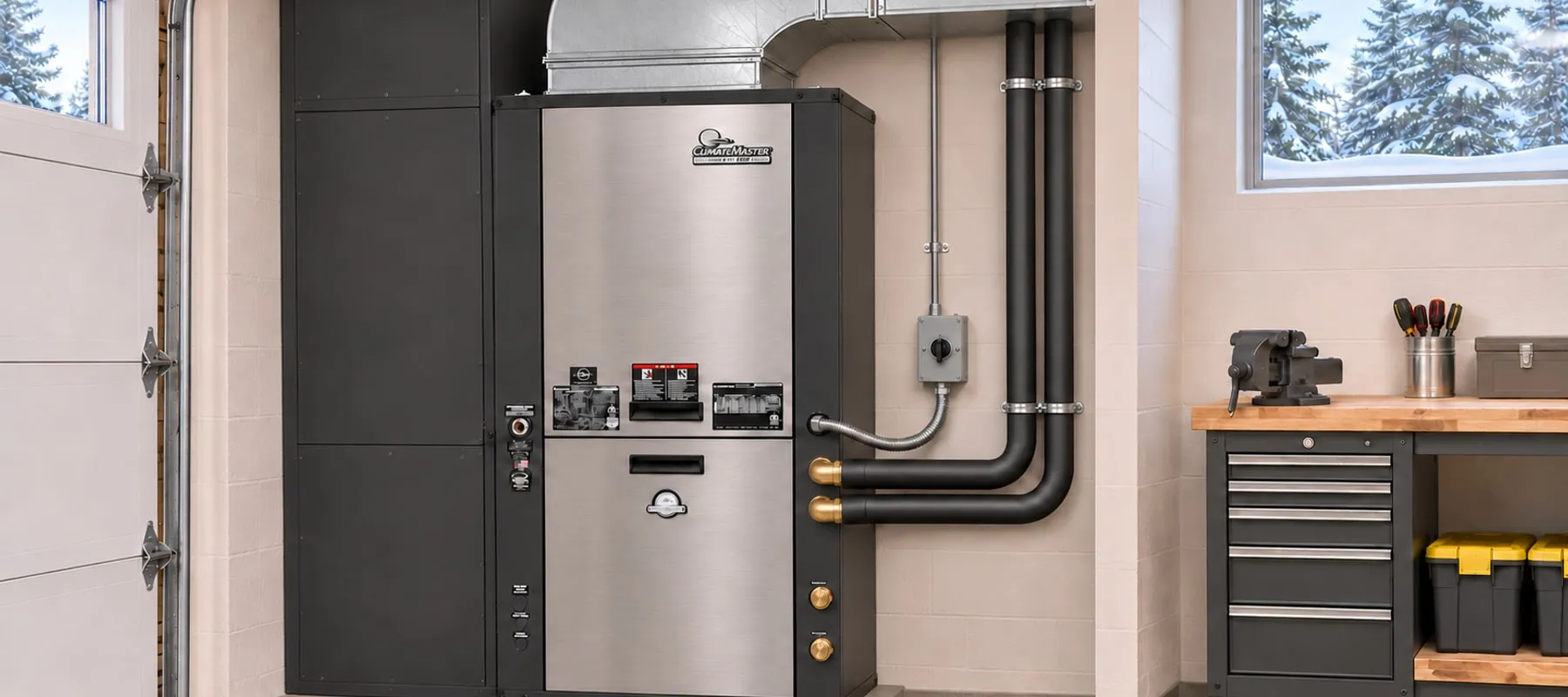
Who stands behind ClimateMaster, what its Tranquility 30 is rated for, how the warranty works in Canada, and why owner results depend on the loop and installer.
ClimateMaster makes ground-source and water-source heat pumps, and its
residential Tranquility line is a credible option for a Canadian home with a
usable loop site and a strong local installer. The maker rates the Tranquility
30 (TE) at up to 29.6 EER under ground-loop test conditions and backs it with
a 10-year parts warranty and a 5-year labour allowance that applies in Canada.
Most owner evidence we found is American, anecdotal and dated, and it splits
sharply between trouble-free decades and expensive failures, so the installer
and loop design matter as much as the unit.
ClimateMaster's product page says it is "a subsidiary of Climate Control Group,
a NIBE company", and the same page links sister companies CCG, ClimaCool,
ClimateCraft, IEC, TTI and KOAX. ClimateMaster's August 2026 company release,
carried by ACHR News, gives an Oklahoma City, Oklahoma base, and the product
page says its equipment is "engineered and assembled in the USA". We did not
read any link between ClimateMaster and Nortek or Madison, which some older
sources suggest, so this page makes no claim about them.
ClimateMaster's packaged residential line includes the Tranquility 30 (TE)
two-stage series, alongside TZ and TS series listed on the same page. We could
not confirm from the Canadian pages which of these are stocked in Canada, so ask
the dealer. The Tranquility 30 TE page lists:
The heat pump is only the indoor part. A buried or drilled loop, or a well for
an open loop, does the heat exchange, and a dealer designs and installs the
whole system.
A ground-source unit draws on stable ground temperatures, so its output does not
collapse in a cold snap the way an air-source unit's can. Natural Resources
Canada says ground-source systems can meet Canadian winter loads better than
air-source ones, but that another heat source may still be needed for peak
demand. ClimateMaster's EER and COP figures are manufacturer ratings at standard
test conditions, not measurements of your house, loop or ductwork, and we did
not find independent Canadian field monitoring of ClimateMaster equipment. What
the loop delivers in January depends on its length, soil, flow and the
entering-water temperature the designer assumed, so ask for that design
temperature and the auxiliary heat in writing.
The most substantial feedback is a High Performance HVAC comment page with 32
comments from 2016 to 2023, mostly US owners. It is unverified, hosted on a site
with commercial links, and the operator replies that results are only as good as
the installer. The pattern, not any single claim, is what is worth noting:
A 2009 Heating Help forum thread adds only trade hearsay, including one
installer's doubts about factory support. We found no Canadian owner reviews,
and we did not open HomeStars, BBB or Reddit threads, so there are no Canadian
complaint counts.
ClimateMaster's residential limited warranty, as printed in its Tranquility TE
installation manual and a sample certificate (RP851), covers one- and two-family
homes in the United States or Canada. Key terms:
Owner complaints that labour was "partly covered" and that replacement parts
carry 90 days match these written terms. A loop installed by someone else is
outside the unit warranty, so get a separate written workmanship warranty for
the loop and pumping. We read a sample certificate and the manual, not a
separate Canadian certificate, so confirm current terms with the dealer.
Solenery does not set prices, and ClimateMaster does not publish Canadian
installed prices. These are third-party references for ground-source systems
generally, and they conflict:
| Source (date) | Reference |
|---|---|
| Carrier Canada, a competing manufacturer (undated page) | $16,200 to $60,000 CAD installed in one place, $10,000 to $30,000 in its FAQ |
| City of Toronto, cited by Get a Better Quote (page updated July 23, 2026; City page modified March 6, 2026) | up to $30,000 for a 3.5- to 4-ton single-home retrofit; excludes ductwork and electrical upgrades |
| Bryan's Fuel, Orangeville price sheet (2024), cited by Get a Better Quote | $29,314 to $46,485 for 3- to 4-ton closed-loop packages; HST and electrical excluded; vertical loop adds $3,000 per ton |
Get a Better Quote, a quote-comparison site, says it found no reliable
Ontario-wide average and offers these only as quote-checking anchors. Carrier's
own page contradicts itself, so treat both ranges as rough. Rural horizontal
loops are usually cheaper than urban vertical drilling, and duct, electrical and
restoration work are often separate lines. Get at least three written quotes
that itemize unit, loop, ductwork and electrical work.
Use the
federal product-list guidance
and the exact model combination on your bid to check ground-source eligibility.
If the quote reuses an existing loop, ask whether indoor-equipment replacement
qualifies and which installation documents are required.
Explore heat-pump rebates you may qualify for through a property assessment.
Explore heat-pump rebatesClimateMaster suits owners with a long time horizon, ideally replacing propane,
oil or electric heat, with room for a loop or budget for drilling, and a
certified local installer with references. Compare more options if upfront cost,
lot size or a shorter stay matters more: ground-source and air-source are
different decisions, and a cold-climate air-source system may fit better. A
replacement is worth quoting when the existing loop passes testing and a local
geothermal contractor supports the equipment.
A licensed brand now under Bosch that shares platforms with Coleman and Luxaire. What a Quebec...
A Whisperline heat pump is part of a building loop, so replacing one is a building decision....
A ground-source brand where the buried loop matters as much as the unit. What WaterFurnace...