Heat Pumps
York HH8 and Affinity Heat Pump Review
A licensed brand now under Bosch that shares platforms with Coleman and Luxaire. What a Quebec...
5 min

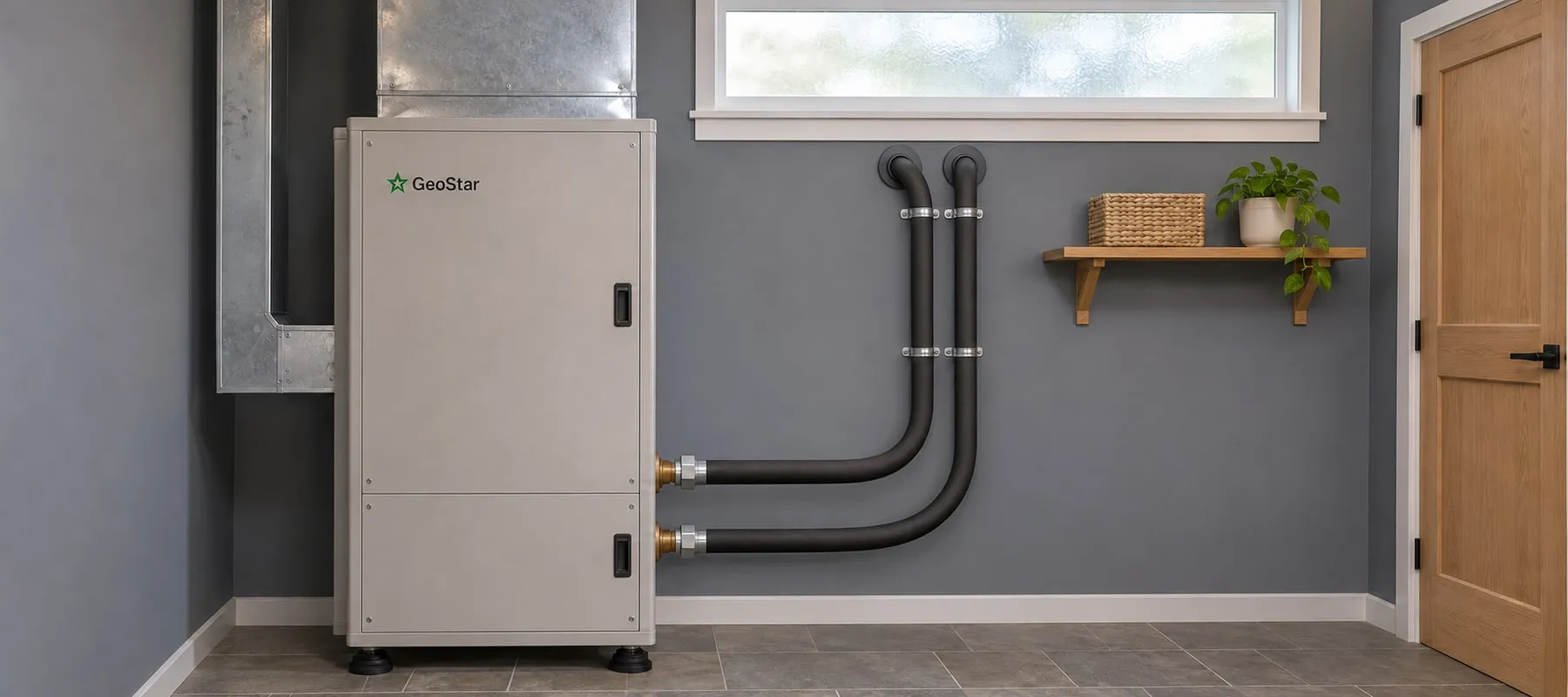
GeoStar is a distributor-only geothermal label built by the same company as WaterFurnace. Here is what the maker’s documents show and what is still unknown.
GeoStar is a ground-source (geothermal) heat pump brand made by the company
behind WaterFurnace and sold
only through select distributors, so you usually reach it through an
installer, not directly. The maker's own documents confirm the link, but we
found no GeoStar owner reviews, no Canadian warranty terms and no current list
of Canadian distributors. The ground loop will drive the price and the risk
more than the brand name.
Three sources agree on the relationship:
So GeoStar and WaterFurnace share a manufacturer. None of these documents says
which parts or designs are identical between GeoStar and WaterFurnace lines, so
treat them as related, not identical. The 2010 articles also described Canadian
distributors, but the pages we re-read did not name any, and we found no current
dealer list for Canada. Ask the installer which distributor supplies your unit.
GeoSmart is a third label from
the same maker.
GeoStar's residential product page currently lists these lines, which it
describes as using R-454B (low-GWP) refrigerant, with R-410A literature still
linked:
The ENERGY STAR certification document lists model numbers for the Sycamore,
Aston and Magnolia Plus lines in closed-loop and open-loop versions. For
Sycamore sizes 036, 048 and 060, a 01/23 brochure for the R-410A version, which
says it was manufactured by WFI Industries, lists closed-loop ratings of 3.4 to
3.5 heating COP at full load and 5.1 at part load, and 19.1 to 21.6 EER at full
load. Those are the maker's ISO 13256-1 ratings under test conditions, not field
performance. We did not find independent test results for GeoStar equipment.
The Aston outdoor split is described as an easy replacement for an air-source
heat pump, with the loop pumps self-contained in the unit. Matching air handlers
are available, or the equipment can be paired with a gas or propane furnace for
a dual-fuel setup.
We found a warranty registration portal on GeoStar's site, but no warranty terms
we could read, so we cannot report coverage lengths, labour terms or loop
exclusions. Registration appears to be handled online by the installer or owner.
Ask the installer for the written certificate for your exact model and Canadian
address, and who pays for labour and refrigerant on a compressor claim.
We found no GeoStar owner or installer reviews on the pages we could read. We
did not individually check HomeStars, BBB or RedFlagDeals. A distributor-only
brand is rarely named to homeowners, so the gap may say little about quality.
Ask the installer for references from past GeoStar installations and for the age
of those systems.
Solenery does not set prices, and GeoStar does not publish them. These are
third-party estimates for a complete ground-source system, not GeoStar quotes:
| Source (updated) | Ground-source system, installed |
|---|---|
| RenoQuotes (January 27, 2026) | about $20,000 to $50,000 for an average-sized home |
| Carrier Canada, a competing manufacturer (undated page) | $16,200 to $60,000 CAD |
RenoQuotes gives a heat pump installation range of $2,000 to $15,000 in a
separate 2026 guide (updated August 25, 2026), which covers air-source
equipment. The gap comes mostly from the buried loop and drilling, which is why
ground-source and air-source are separate decisions. Natural Resources Canada
says an ENERGY STAR ground-source heat pump uses 45% less energy on average than
a standard model, and that another heat source may still be needed for peak
demand.
Use the
federal product-list guidance
to look up the exact GeoStar model under the current ground-source rules. For a
retrofit, ask which costs are for indoor equipment and which are for testing,
pumping or loop work.
Explore heat-pump rebates you may qualify for through a property assessment.
Explore heat-pump rebatesA licensed brand now under Bosch that shares platforms with Coleman and Luxaire. What a Quebec...
A Whisperline heat pump is part of a building loop, so replacing one is a building decision....
A ground-source brand where the buried loop matters as much as the unit. What WaterFurnace...