Heat Pumps
York HH8 and Affinity Heat Pump Review
A licensed brand now under Bosch that shares platforms with Coleman and Luxaire. What a Quebec...
5 min

A Montreal direct-to-consumer brand. Its warranty differs by series, requires a licensed installer and registration, and does not pay for labour.
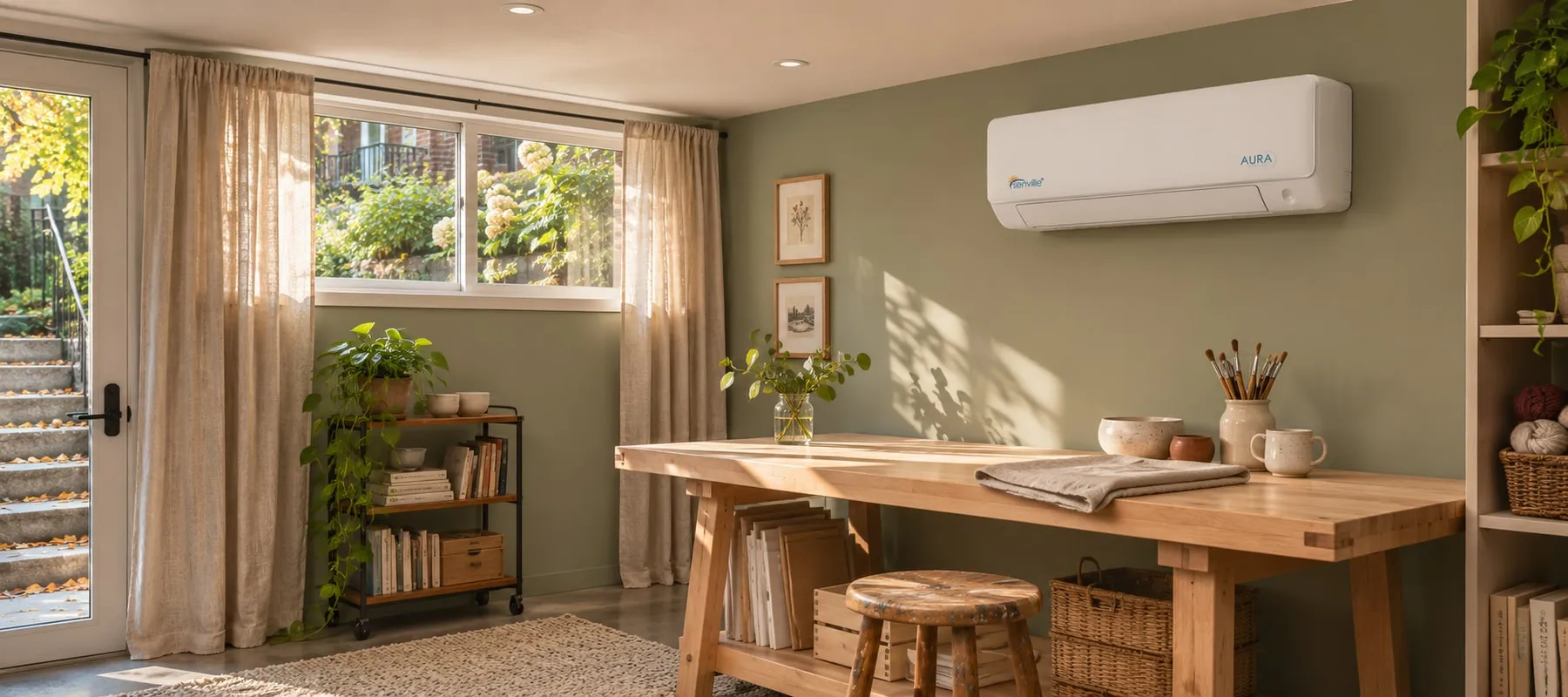
Senville is a Montreal brand that sells mini-splits direct to consumers online. Its AURA line is rated to run down to −22 °F (−30 °C), and an affiliate comparison site relays a NEEP listing showing 94% of rated heat at 5 °F for one pairing. The warranty is the main catch: Senville's help centre ties coverage to registration and licensed installation, and labour is never covered.
Senville's help centre lists four ranges. AURA (SENA) is the cold-climate line, with single-zone, multi-zone and floor-console units. LETO (SENL) is the cheaper range. Elite (SENE) and the Central ducted heat pumps (SENDC, plus top-discharge SENTC) are also listed. Boldr, a competing seller, says Senville designs and distributes units "manufactured on a Midea platform" from Montreal; we found no Senville statement, so treat the maker as unconfirmed. Senville sells direct, so the installer is someone you arrange yourself.
Furnaceprices.ca (updated September 1, 2026) lists the SENL single-zone at up to 21.5 SEER2 and 9.6 HSPF2, the multi-zone SENA at up to 27.4 SEER2 and 13.5 HSPF2, and the SENDC central unit at 18.3 SEER2 and 10.2 HSPF2.
Mini Split Compare, a site that earns affiliate commissions, shows a 12,000 Btuh AURA pairing listed at 94% of its rated heat at 5 °F (−15 °C) with a COP of 1.88, citing the NEEP listing for that pairing, and says Senville rates it to run to −22 °F. We did not open NEEP ourselves, and the figure covers one pairing, not the whole line. We could not read Senville's own Canadian product page, which blocked automated reading, so we do not repeat its −30 °C or efficiency claims.
Boldr's cold-climate guide places the Senville AURA at the market's −22 °F (−30 °C) limit alongside select Cooper & Hunter units, which is a seller's summary of manufacturer ratings. As with any mini-split, an operating limit is not output at that temperature. Keep a backup heat source for the coldest nights, and ask for the AHRI or NEEP capacity table for your exact pairing.
Senville's help centre (the article shows "Modified on Thu, 8 Oct", with no year) states:
| Series | Parts | Compressor |
|---|---|---|
| AURA (current models) and Central | 5 years | 10 years |
| LETO (current) | 5 years | 5 years |
| Elite | 10 years | 10 years |
| Earlier AURA (IZ/OZ endings) | 3 years | 7 years |
| Earlier LETO (IX/OX) | 2 years | 5 years |
The article says labour for repairs is not covered, 10 years of Senville Tech+ support are included, registration is required for coverage in the US and Canada, and a licensed HVAC technician must pressure-test and evacuate the line sets and release the charge, or the warranty is void. It names the model-number endings that set the generation, so check the label.
Sources conflict: Furnaceprices.ca says there is no registration-based extension and no labour or unit replacement. Senville's help centre says registration is required for coverage. Get Senville's written terms for your model, register it, and keep the installer's pressure-test record.
Solenery does not set prices. Furnaceprices.ca (updated September 1, 2026) gives installed ranges:
| System | Installed range |
|---|---|
| Single-zone (SENL) | about $3,000 to $5,500 |
| Multi-zone (SENA) | about $6,500 to $12,000+ |
| Ducted central (SENDC) | about $6,000 to $10,000 |
Furnaceprices.ca notes that Senville sells equipment direct, so the hardware cost is often lower than a dealer-supplied system, with professional installation added on top. We could not read Senville's store, so confirm the equipment price there. Add the installer's labour, electrical work and the licensed pressure test.
Use the federal product-list guidance to verify the matched equipment. Eligibility depends on the exact outdoor and indoor combination, so get both model numbers before you order.
Explore heat-pump rebates you may qualify for through a property assessment.
Explore heat-pump rebatesSenville suits a buyer who is comfortable arranging a licensed installer, accepts a labour-free warranty and wants low equipment cost for a home without ducts. If you want a dealer network that handles installation and service together, compare Mitsubishi or Fujitsu.
A licensed brand now under Bosch that shares platforms with Coleman and Luxaire. What a Quebec...
A Whisperline heat pump is part of a building loop, so replacing one is a building decision....
A ground-source brand where the buried loop matters as much as the unit. What WaterFurnace...